
FASST-CH Roadmap
Two specific phases of the roadmap are defined.
a) 2028: an i-conspicuity ecosystem
In line with EASA initiatives (EASA launches new initiatives to prevent mid-air collisions in General Aviation | EASA), safety for VFR and IFR is enhanced by introducing an e-conspicuity mandate in Switzerland. By 2028, all manned flights are electronically visible using a mix of suitable and interoperable technologies. This lays the foundation for the uplink transmission of data in the cockpit, a real solid step towards digitalised airspace. The integration of unmanned aerial vehicles in class G is facilitated.
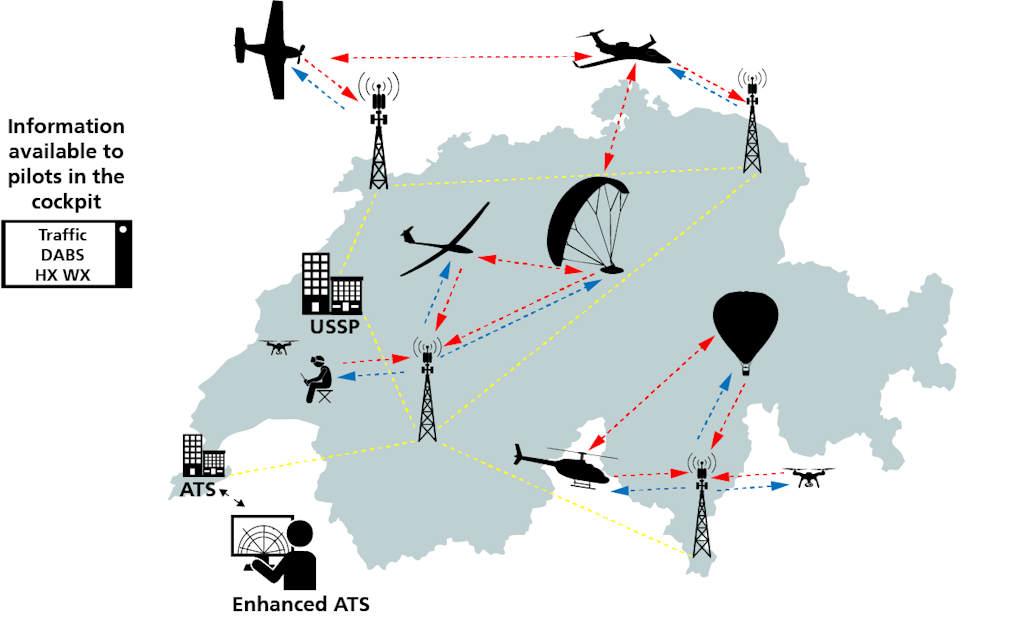
This interoperable ecosystem has following features.
- Air-to-air: Each airspace user is equipped with electronic systems that transmit real time data (position, speed, …). They also receive the same information from other aircraft in the vicinity. This direct communication enables pilots to detect traffic in their area.
- Ground-to-air and air-to-ground: A network of ground stations collects and processes the traffic data sent by aircraft and sends it to other airspace users. These data enlarge and complete the picture of pilots.
- Airspace monitoring: These data allow real time airspace monitoring providing an overview of all traffic and support multiple stakeholders.
- Additional advantages: An interoperable ecosystem means that airspace users can also receive updates on weather conditions or restricted airspace, like FIS-B in the US. This enables the industry to develop tools to support pilots, enabling them to utilise the data in the cockpit.
b) 2035: a fully connected airspace
By 2035, a fully connected airspace will be established. Within this, users will be able to access key data in real time, such as traffic, weather and airspace status. This connectivity enables flexible, real-time allocation of resources. As the data is stored in the cloud, it can be shared.