In Switzerland, EASA Part-NCO applies to pilots and operators of non-complex motor-powered aircraft. Its applicability covers both EASA and Annex I aircraft.
Part-NCO also applies to foreign-registered aircraft if the operator's place of business is located in Switzerland or in an EASA member state.
Yes, since July 1st 2023, Part-NCO also applies to certain Annex I aircraft in Switzerland. If an equipment requirement cannot be met, this must be declared to the FOCA. Further details can be found in Ordinance SR 748.127.7 and in the presentation below on the subject of minimum equipment under Part-NCO.
Other than complex motor-powered aircraft means an aircraft that is not:
An aeroplane:
with a maximum certificated take-off mass exceeding 5'700 kg, or
certificated for a maximum passenger seating configuration of more than 19, or
certificated for operation with a minimum crew of at least two pilots, or
equipped with (a) turbojet engine(s) or more than one turboprop engine, or
more than one turboprop engine and a MCTOM exceeding 5'700 kg.
A helicopter:
with a maximum take-off mass exceeding 3'175 kg, or
certificated for a maximum passenger seating configuration of more than nine, or
certificated for operation with a minimum crew of at least two pilots.
A tilt rotor aircraft
Prior to each flight the Pilot in Command (PIC) has to decide if the intended flight may be performed according to the installed and operational status of the equipment.
The minimum equipment for a particular flight is determined by several elements. On the one hand there are requirements from the original or amended aircraft certification (TCDS, STC, AD), on the other hand there are operational requirements from Part-NCO. A detailed overview and a PIC decision sequence for inoperative equipment can be found in the presentation below.
According to article 6 paragraph 4a(c) of the Commission Regulation (EU) No. 965/2012 specific profit yielding activities under Part-NCO may be carried out:
(c) introductory flights, parachute dropping, sailplane towing or aerobatic flights performed either by a training organisation having its principal place of business in a Member State and approved in accordance with Regulation (EU) No 1178/2011, or by an organisation created with the aim of promoting aerial sport or leisure aviation, on the condition that the aircraft is operated by the organisation on the basis of ownership or dry lease, that the flight does not generate profits distributed outside of the organisation, and that whenever non-members of the organisation are involved, such flights represent only a marginal activity of the organisation.
FOCA has developed conditions for introductory flights and parachute dropping:
The conditions for introductory flights according to AMC1 ARO.OPS.300 Introductory flights are outlined in the following FOCA Guidance Material:
Use the latest version of Adobe Reader to open the form.
The conditions for parachute dropping under marginal activity are the following:
Marginal activity for parachute dropping is defined
as being «Less than 20% of the parachute drops per calendar year of all aircraft operated by the organisation may be tandem parachute drops»
Oversight by nominated person
The organisation shall designate a person responsible for their safety
Flights only within Switzerland
Flights shall be operated within the geographical borders of Switzerland and Liechtenstein (any cross-border operations are subject to the conditions of the concerned member state).
Only other-than-complex motor-powered aircraft
Pilot Qualification
Pilots must either have a CPL/ATPL or a PPL and the following requirements must be met:
> total flight experience of at least 100 hours and a minimum of 20 drop-rotations within the last calender year on the type or class being used for the activity (parachute dropping); or
> a training and a check flight on the type or class being used for the activity (parachute dropping) with a flight instructor of that organisation qualified for parachute dropping.
Theoretical and practical instruction and annual check flight
The pilot shall provide proof of theoretical (based on the information provided here – conditions for marginal activity operations) and practical instruction (parachute dropping specific SOP's, abnormalities etc.) by the designated person. In addition, an annual check flight with the designated/nominated person shall take place.
No flights in the sense of crediting for a license or rating
Prospective activity declaration and annual reporting of the flights carried out
The organisation shall announce the prospective activity in the year in which they intend to operate such parachute dropping under marginal activity. At the end of the year the annual activity shall be reported to the FOCA. The relevant forms are found here:
Use the latest version of Adobe Reader to open the form.
For each year, the operator shall fill in a new «Marginal Activity» form. The operator indicates how many parachute drops and tandem parachute drops have been completed in total. In addition, it is to be reported how many parachute drops the operator intends to complete in the following year and how many of these can be classified as marginal activity. The information is examined by the FOCA each year and checked during inspections at least every four years on site.
Fees
Article 45 of the Fees Regulation of the FOCA (SR 748.112.11) states that a fee is charged on a time basis for a licence, confirmation or operational audit for non-commercial operations with other-than-complex motor-powered aircraft as well as for their modification, restriction or withdrawal.
Specific Approvals and MEL
A Specific Approval is required if, for example, an RVSM authorisation is desired.
For the application, deletion or change of an approval according to EASA Part-SPA or other changes to be handled with the FOCA according to the EASA regulations applicable to the type of operation, see Changes at Aircraft Operator.
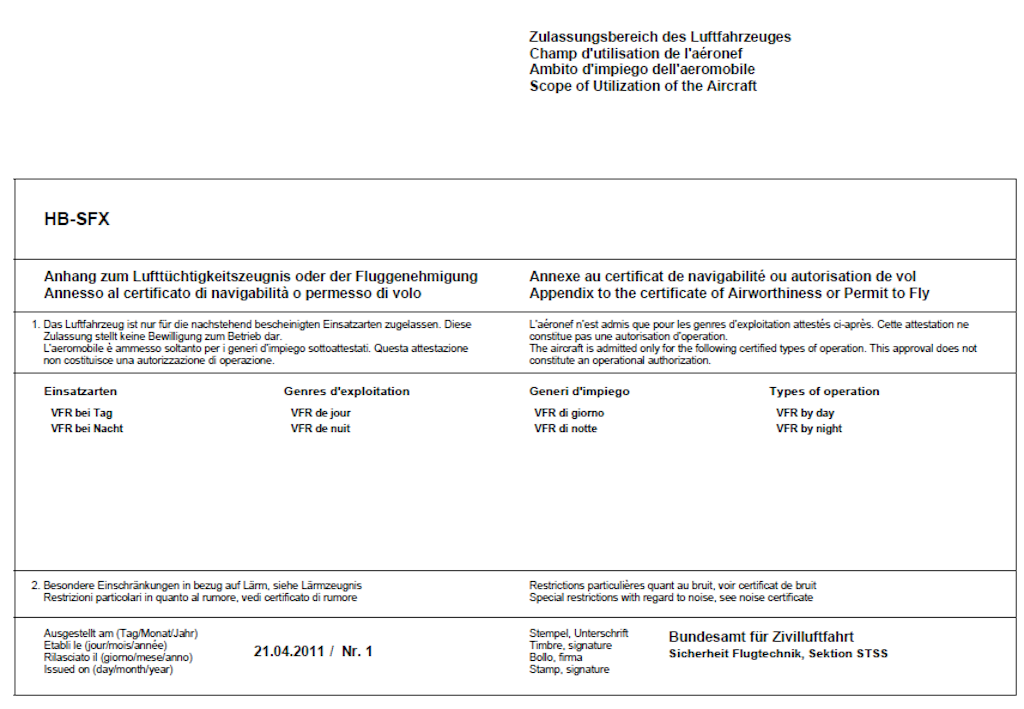
Scope of Utilization of the Aircraft
With the introduction of Part-NCO, changes to the practices of the previous equipment requirements for the respective flight operations (VFR, VFR night, IFR) are taking place.
The scope of utilisation of the aircraft, previously issued by FOCA, is being overridden by the new legal basis for an aircraft concerned by Part-NCO. The possible types of operation now directly result from the .IDE-provisions of the Part-NCO, respectively TCDS/AFM/AFMS (see Guidance Material). They no longer derive from the scope of utilisation of the aircraft.
We therefore ask the aircraft operators to return their scope of utilisation to the aircraft registry at FOCA.
Federal Office of Civil Aviation FOCA
Aircraft Registry P.O. Box
CH-3003 Berne
The “Aussenlandeverordnung (AuLaV)” dated 14 May 2014 regulates the departures and landing by aircraft outside of airports. Website FOCA Helicopters - National law.
Pilots should only complete this document when requested to do so by the FOCA. It should be returned by email to sbfl@bazl.admin.ch. Its purpose is to provide information on the background to any incidents or accidents. The form in no way replaces the report made on the official Reporting Portal; all incidents, serious incidents and accidents must still be reported to the FOCA.