If you wish to fly without a FOCA authorisation, you must comply with the general flight rules for the open category. Below you will find full information on flying an aircraft in the open category. Rules that also apply in the specific category are indicated.
If you wish to fly without a FOCA authorisation, you must comply with the general flight rules for the open category. Below you will find full information on flying an aircraft in the open category. Rules that also apply in the specific category are indicated.
The information sheet below summarizes the general flight rules and is intended to support remote pilots during their operations.
Flights in the open and specific categories may only be carried out by registered drone operators. You can find more information on this under Registration as a drone operator.
Flights in the open and specific categories may only be performed by remote pilots with the required qualifications. Further information can be found under Training and certificates for remote pilots.
During the flight
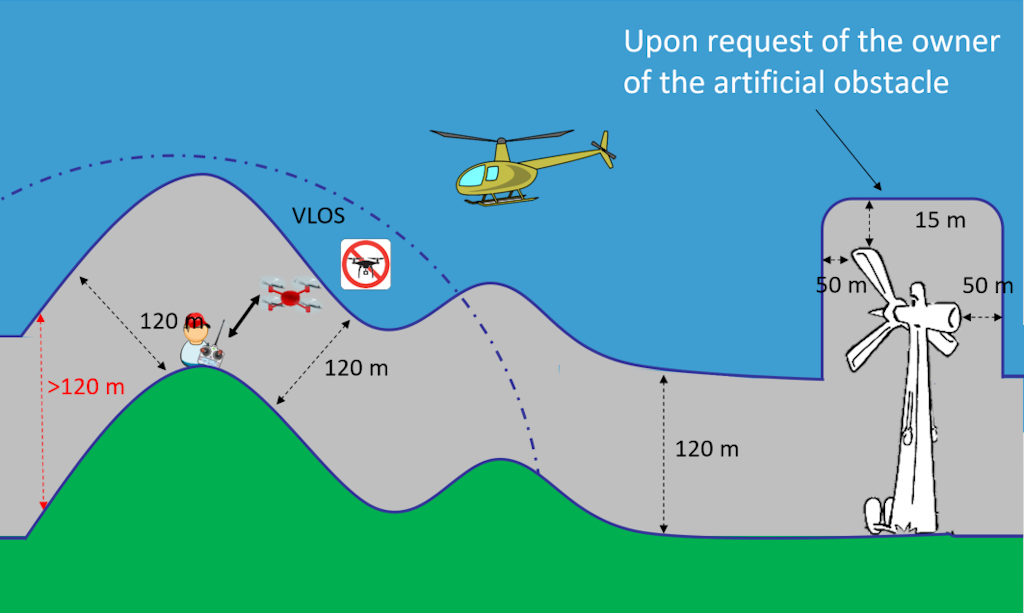
In the open category, a drone may be flown at a maximum altitude of 120m above ground level.
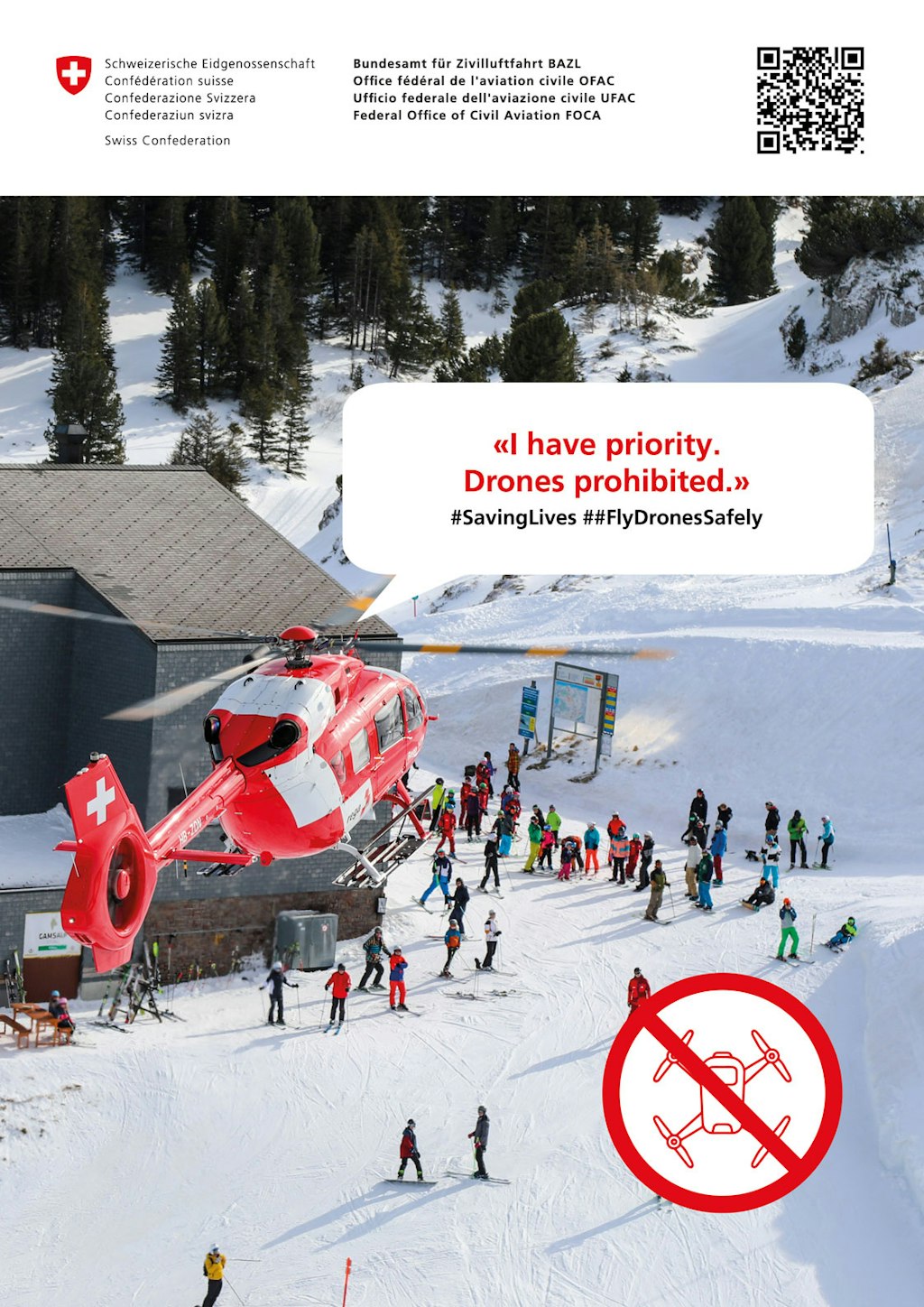
Flying over assemblies of people is prohibited in the open category. Assemblies are defined as any large number of people standing so close together that it is almost impossible for a single person to move away and not be part of the assembly. Such a situation exists at events of all kinds, on ski slopes, in crowded shopping streets, busy parks and on beaches, etc.
Flights in the open category take place in one of the sub-categories A1, A2 or A3. Different rules apply regarding the distance to uninvolved persons in each of these sub-categories. The rules are explained below.
Uninvolved persons: Persons who are not taking part in the drone flight or who do not know the instructions and safety regulations of the drone operator.
A drone in the open category may only be flown within visual line of sight. This allows the remote pilot to clearly see in which direction the drone is flying and observe the surrounding airspace in order to avoid other air traffic. VLOS flights are also permitted at night, provided the drone is equipped with position lights. However, as visibility is limited, the distance between the pilot and the drone must be shortened accordingly. Flying beyond visual line of sight (BVLOS) is not permitted in the open category.
For first person view (FPV) flights, please refer to the section on special rules for FPV.
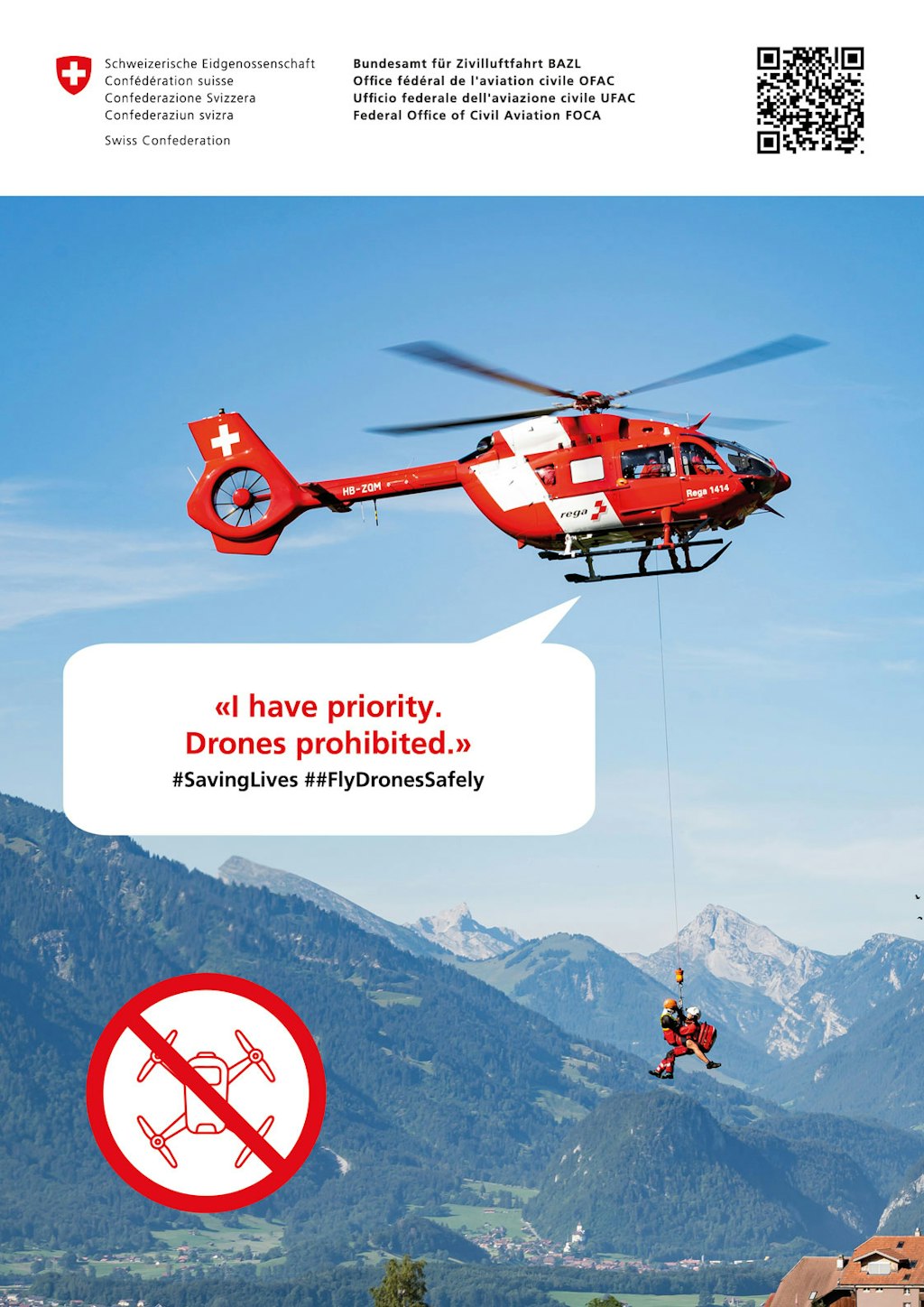
Manned aircraft must be given priority at all times. Since an aircraft pilot stands little chance of seeing a small drone early enough to react, it is the responsibility of the drone pilot to take evasive action in good time and to always keep enough distance between their drone and other aircraft.
Authorisation is required to fly in an area with flight restrictions. This authorisation is issued by the authority responsible for the no-fly zone, not by the FOCA. Authorisation is required in both the open and the specific categories. Further information can be found under Geographical flight restrictions.
The emergency services (police, fire brigade, etc.) must not be hindered or disturbed in their work. If the emergency services are deployed in the vicinity of your flight, you must land your drone immediately.
Remote ID must be switched on during the flight so that the drone can be identified and is visible digitally. This applies to both the open and the specific category. This function can be activated in the drone settings and is usually found under ‘Remote identification’ or ‘Remote ID’. To activate the Remote ID, the UAS operator number (CHExxxxxxxxxxxxxx-xyz) must be entered in the field provided.
Class C0 drones, legacy drones and privately built drones are exempt from this rule.
You must respect the privacy of other people when flying in the open and specific categories. Strangers may not be filmed or photographed, and drones may not be flown low over private property. More information can be found under Privacy & data protection.
Possible operations by drone class
There are three sub-categories in the open category: A1, A2 and A3. The drone class determines the sub-category in which the drone may be flown. Further information on classes and class identification labels (CILs) can be found under Consumer information.
Possible operation with unclassed drones
For drones without a CIL, the possible operation is determined by the drone’s weight. This applies primarily to privately built drones and drones that were placed on the market before 1 January 2024 (legacy drones). Drones without a CIL that do not fall into either category may not be used in the open category.
Drones that do not bear a CIL and were placed on the market by the manufacturer before 1 January 2024 are known as legacy drones. The operations possible with legacy drones are shown in the table below. Further information on class identification labels can be found on the Consumer information page.
A drone is considered to be privately built if the drone and its equipment have been assembled or built for personal use. Drones assembled from a set of parts (kit) are not included in this definition. The remote pilot must ensure that the drone is properly assembled and poses no safety risks. The drone should not have a class identification label.
A1 safety distance
Besides the aforementioned general flight rules, specific regulations apply in sub-category A1 regarding the safety distance to uninvolved persons.
Class C0 / Legacy drones under 250g / Privately built drones under 250g: It is permitted to overfly uninvolved persons.
Class C1: Drones should not be flown over uninvolved persons. If the drone overflies uninvolved persons unexpectedly, the pilot must steer it away from the uninvolved persons immediately.
A2 safety distance
Besides the general flight rules above, specific regulations apply in sub-category A2 regarding the safety distance to uninvolved persons.
It is not permitted to overfly uninvolved persons.
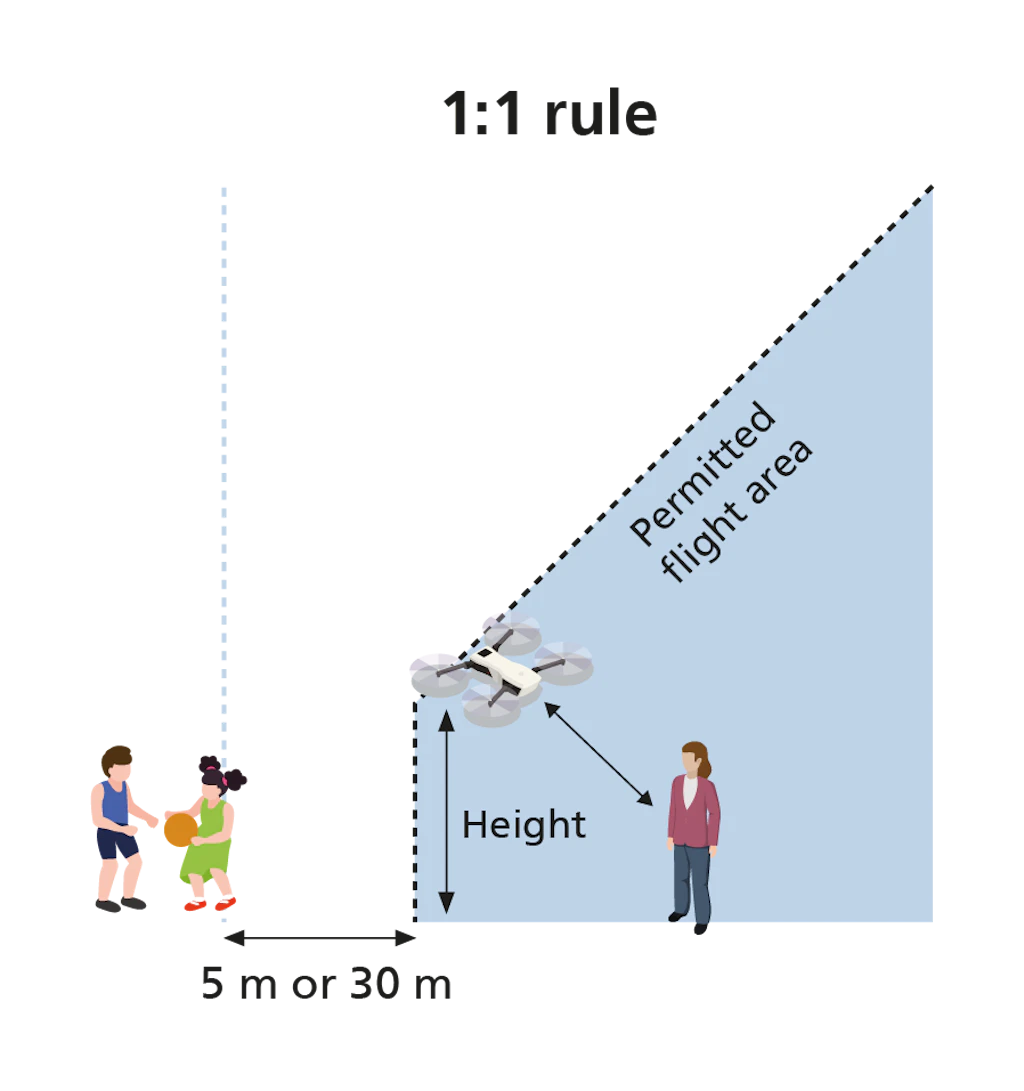
A safe horizontal distance to uninvolved persons must be maintained. This must be the greater of the following two distances:
a minimum distance of 30 metres (or 5 metres in low speed mode);
a distance at least equal to the height at which the drone is flying (1:1 rule).
Examples: When a drone is flown at a height of 40 metres, the distance to uninvolved persons must be at least 40 metres. However, when a drone is flown at a height of 20 metres, the horizontal distance to uninvolved persons must be at least 30 metres.
Here you can see a schematic representation of the minimum safety distance. Up to a height of 30m above the ground, the distance is 30m. Thereafter, it increases according to the 1:1 rule.
A3 safety distance
Besides the general flight rules above, specific regulations apply in sub-category A3 regarding the safety distance to uninvolved persons.
It is not permitted to overfly uninvolved persons.
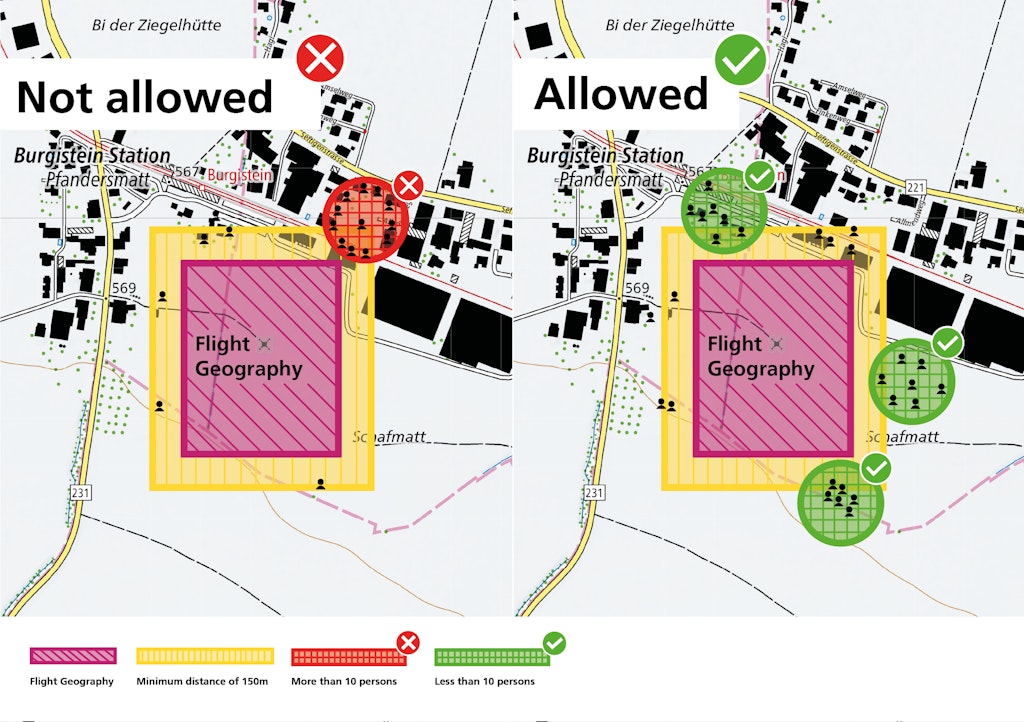
A horizontal distance of at least 150 metres must be maintained from residential, commercial, industrial and recreational areas. Further explanations and examples can be found at the end of this section.
A safe horizontal distance from uninvolved persons must also be maintained. This must be the greater of the following two distances:
at least 30 metres;
a distance at least equal to the height at which the drone is flying (1:1 rule). For example: When flying a drone at a height of 40 metres, the distance to uninvolved persons must be at least 40 metres.
Example: You are flying your drone at some distance from a populated area (distance of 150 metres from residential, commercial, industrial and recreational areas) and encounter a person out for a walk. Your drone must be flown at least 30 metres away and no closer to this person than the height at which the drone is flying.
Here you can see a schematic representation of the safe minimum distance. Up to a height of 30m above the ground, the distance is 30m. Thereafter, it increases according to the 1:1 rule.
Drones may be flown in an area in which no uninvolved persons will be endangered within its range. The remote pilot is responsible for inspecting the area before and during the drone operation to assess whether the above-mentioned conditions can be complied with. The remote pilot must maintain a minimum horizontal distance of 150 metres from areas in which there are ten or more uninvolved persons within a radius of 100 metres at the time of operation.
Example A: Drone operator A wants to fly a drone weighing 15kg to take some photographs. The flight takes place in sub-category A3. The drone is to be flown near a leisure and sports complex, which includes an outdoor swimming pool and a car park. Intending to fly early in the morning, the drone operator inspects the site and finds that not many people have arrived at the complex yet and that there are fewer than 10 people in the area. They therefore decide that it is safe to fly and continuously monitor the area and the number of people in the vicinity.
Example B: Drone operator B has to carry out an inspection of a building with a 20kg drone. The flight takes place in sub-category A3. The drone is to be flown in a commercial area where large shopping centres are located. Drone operator B plans to fly the drone on a Sunday, when the shopping centres are closed and there are no people in the area apart from a couple walking their dog. The operator looks around the area and sees that there are fewer than 10 uninvolved persons in the vicinity of the operation. While the drone is in the air, they continuously monitor the area to ensure that the situation remains safe at all times.
Special FPV rules
Drones that can be flown using video goggles are known as FPV (first person view) drones. The following regulations apply to the use of video goggles during drone flights:
The remote pilot is assisted by an observer (also known as a spotter or airspace observer) who is positioned beside them. The airspace observer keeps the drone in visual line of sight (VLOS) with the naked eye at all times.
The airspace observer is responsible for monitoring the airspace and actively communicates their observations to the remote pilot, warning the latter in the event of danger or an approaching aircraft.
If the airspace observer does not keep the drone in VLOS at all times or an FPV flight is performed without an airspace observer, it is considered a flight beyond visual line of sight (BVLOS). BVLOS flights fall into the specific category and must therefore be authorised by the FOCA.
‘Specific’ requirements?
Provided the general flight rules of the open category are followed, drones can be flown without authorisation from the FOCA. If the drone operator cannot or does not wish to adhere to the rules of the open category, the rules of the specific category apply. Operating a drone in the specific category requires authorisation from the FOCA. This is the case when the drone:
Delegated Regulation (EU) 2019/945 Regulation (EU) 2019/1020 of the European Parliament and of the Council of 20 June 2019 on market surveillance and compliance of products and amending Directive 2004/42/EC and Regulations (EC) No 765/2008 and (EU) No 305/2011