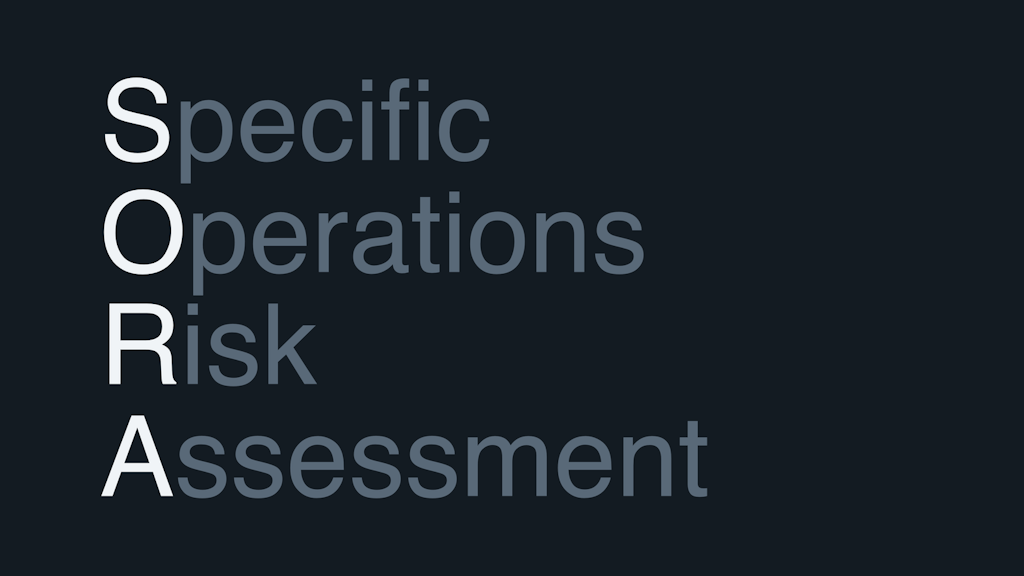
When conducting an operation not covered by a STS or a PDRA, applicants are required to conduct a risk assessment, identify mitigations and comply with safety objectives. The risk assessment methodology, known as SORA (Specific Operations Risk Assessment), is developed for this purpose. EASA published the SORA as an Acceptable Mean of Compliance (AMC) to Article 11 to Regulation (EU) 2019/947.
Due to the very high number of applications, processing times are currently longer than usual. We thank you for your patience and understanding. Each application is reviewed with the required level of attention.
Use of consulting companies
Operators may engage consulting firms to assist them in preparing their application. However, the operator remains the sole point of contact for the FOCA. The operator bears full responsibility for the content of the application, its compliance with legal requirements, and for ensuring a thorough understanding and review of all submitted documents.
Prerequisite knowledge
Before submitting an application, the operator must have the necessary knowledge of UAS regulations and risk assessment. This includes, in particular, an understanding of the requirements of Regulation (EU) 2019/947 as well as the principles of the SORA methodology. Depending on the complexity of the intended operation, developing a risk assessment may require a high level of expertise. The operator must be able to understand, justify and maintain full control over all elements included in the application.
Transition from SORA 2.0 to SORA 2.5
The EASA Executive Decision related to SORA 2.5 entered into force on 30.09.2025. As of 01.04.2026, all new SORA applications in Switzerland must be submitted in accordance with SORA 2.5. Authorisations issued by FOCA on the basis of SORA 2.0 remain valid until their indicated expiry date.
Steps for an operational authorisation application
Before starting the SORA process, applicants should verify that the proposed operation is feasible. Things to verify before beginning the SORA process are whether:
the operation is covered by a standard scenario (STS) or by a predefined risk assessment (PDRA);
the operation falls under the ‘certified’ category (e.g. the transport of passengers or dangerous goods posing a high risk to third parties and the environment);
the operation is subject to a specific NO-GO from FOCA.
If none of the above cases applies, the SORA process can be applied. The EASA Drone Rule Navigator can be used to help you identify the type of request that suits your needs.
Be aware that the SORA authorization process usually follows an iterative approach and may involve several rounds of exchanges. It requires close coordination with FOCA and adapts to the complexity of the project. Depending on the adjustments to be made to the safety portfolio following FOCA’s assessment, the overall evaluation may take additional time before it can be finalized.
Before initiating any application process, it is essential to familiarise yourself with the applicable regulatory framework. In this regard, priority should be given to consulting the relevant EU UAS Regulations and the associated Acceptable Means of Compliance (AMC) and Guidance Material (GM) published by EASA. These are compiled in the Easy Access Rules for Unmanned Aircraft Systems.
FOCA also provides its own supporting documentation, available for download below. This documentation will be updated in due course to incorporate the developments related to SORA 2.5. We also recommend carefully reviewing the additional documents available in the “Links” and “Documents” sections at the bottom of this page.
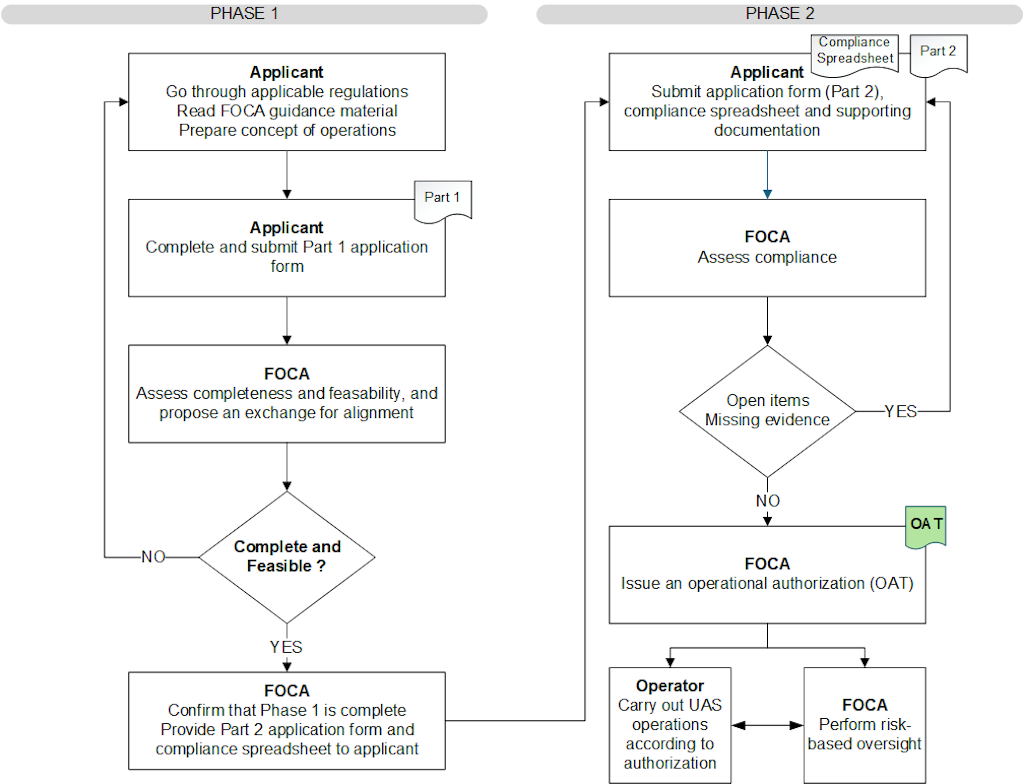
The process begins with the submission of the “Part 1” form. FOCA will then examine the admissibility of the request. In certain cases, a 30-minute meeting may be organized between the applicant and a FOCA UAS expert to clarify specific aspects of the file.
Once the admissibility has been confirmed, the applicant is invited to submit the “Part 2” form, together with the required annexes (as specified in the form), a Master Data List, and a mandatory compliance spreadsheet. The form and the compliance spreadsheet are provided by FOCA to each applicant individually.
FOCA conducts a comprehensive review of the application. In most cases, multiple exchanges between FOCA and the applicant are required before the file can be accepted. Once all conditions are met, FOCA issues an operational authorization, which is valid for a period of two years maximum.
Responsibilities of UAS Operators and Remote Pilots
In accordance with Commission Implementing Regulation (EU) 2019/947, UAS operators remain responsible for ensuring that their operations comply with the applicable regulatory requirements as well as the conditions and limitations associated with their operational authorisation. This responsibility applies throughout the entire validity period of the authorisation.
An operational authorisation is not transferable (UAS.SPEC.070). The operator remains responsible for all operations conducted under its authorisation and must, at all times, retain organisational control over its activities as well as operational control over UAS operations conducted under its responsibility, regardless of any contractual, economic or other relationships that may exist with the remote pilots concerned.
UAS operators are notably responsible for:
conducting operations in accordance with the applicable regulatory requirements;
implementing and maintaining the required operational procedures;
ensuring that remote pilots possess the necessary competencies and qualifications;
maintaining the required documents, records and logbooks;
retaining operational control over their activities;
reporting occurrences where required by the applicable regulations;
cooperating with FOCA during surveillance activities.
complying with the procedures and instructions established by the operator;
conducting UAS operations in accordance with the applicable conditions and limitations;
maintaining the competencies required for the operations performed;
reporting situations that may affect the safety or compliance of operations;
interrupting or not commencing a flight where the conditions necessary to conduct it safely are not met.
Detailed responsibilities applicable to remote pilots are defined in particular in point UAS.SPEC.060.
FOCA Surveillance Activities
In accordance with Article 18 of Commission Implementing Regulation (EU) 2019/947, FOCA conducts surveillance of UAS operators conducting operations in the Specific category in order to verify continued compliance. To help operators better understand surveillance activities and the associated expectations, FOCA has published the following guidance material:
Based on time spent, i.a.w. Art. 38, Para. 1, let. a of the Ordinance on the fees charged by the Federal Office of Civil Aviation (GebV-BAZL; SR 748.112.11)