
Pre-defined Risk Assessment (PDRA)
In the case of a Pre-Defined Risk Assessment (PDRA), the operator must confirm that all predefined conditions are met, as indicated in the corresponding PDRA compliance matrix. Unlike STS, the drone is not required to bear a class identification label. Since PDRAs do not impose specific scenarios, applicants have greater flexibility in performing the drone operation they intend to conduct.
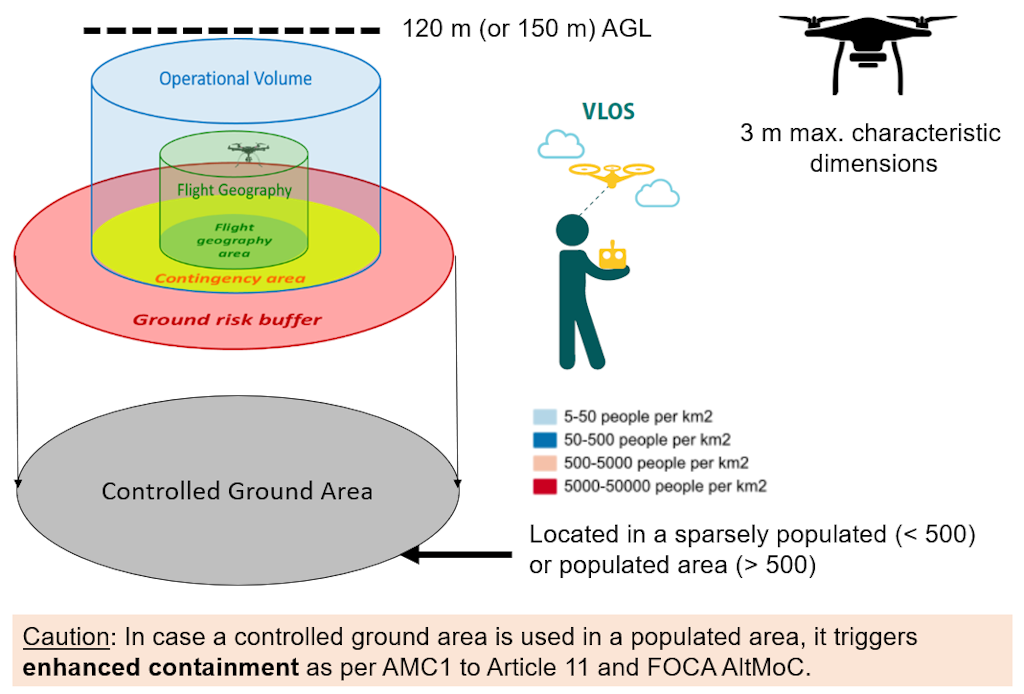
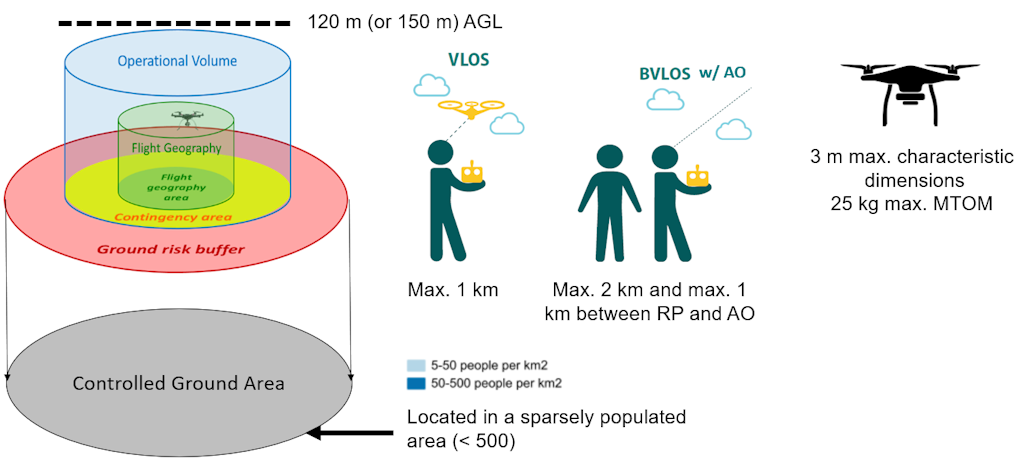
Overview of the conditions for each PDRA
There are two types of PDRA: PDRA-S and PDRA-G.
PDRA-S are the operational counterparts of the standard scenarios STS-01 and STS-02. However, the UAS used do not need to bear C5/C6 class identification labels.
PDRA-G include generic risk assessments for the most common types of operations (e.g. PDRA-G03 for aerial work).
Spraying with drones
For drone spraying operations under a PDRA (e.g. for the application of plant protection products), please refer to the dedicated page: Spraying with drones (SPRAY).
Determining Population Density
To identify the population density applicable to the operational area, use the platform https://map.geo.admin.ch and activate the “SORA Ground Risk” basemap.
While the current PDRAs are still being adapted with the SORA 2.5 specificities in terms of population densities, the following values have to be considered:
- A sparsely populated area corresponds to a population density of ≤ 500 persons/km²
- A populated area corresponds to a population density of > 500 persons/km²
Training of remote pilots for PDRA-S
For PDRA-S01 and PDRA-S02, the remote pilot must in principle hold the STS theoretical certificate (standard scenarios) as well as an STS practical training attestation (see conditions #5.3.4 and #5.3.5). However, condition #5.3.7 allows the UAS operator to propose alternative training arrangements to the competent authority (FOCA). To harmonise practices and ensure a high level of safety, FOCA has published dedicated declaration forms based on predefined training programmes (see below).
Application steps
1. The application for an operational authorization based on a PDRA S-0x and/or G-0x must include:
- The corresponding application form, duly completed and signed, in PDF format (see section "Forms" below).
- All required documents (e.g., operations manual, proof of remote pilot qualification, etc.) as indicated in the application form, in PDF format.
2. Applications must be sent to FOCA, at least 2 months before the intended operation.
3. Once all requirements are met, FOCA can issue an operational authorization, valid for 2 years maximum.
Modification or extension of an authorization
Please refer to the dedicated webpage: Modification or extension of an authorization.
Responsibilities of UAS Operators and Remote Pilots
In accordance with Commission Implementing Regulation (EU) 2019/947, UAS operators remain responsible for ensuring that their operations comply with the applicable regulatory requirements as well as the conditions and limitations associated with their operational authorisation. This responsibility applies throughout the entire validity period of the authorisation.
An operational authorisation is not transferable (UAS.SPEC.070). The operator remains responsible for all operations conducted under its authorisation and must, at all times, retain organisational control over its activities as well as operational control over UAS operations conducted under its responsibility, regardless of any contractual, economic or other relationships that may exist with the remote pilots concerned.
FOCA Surveillance Activities
In accordance with Article 18 of Commission Implementing Regulation (EU) 2019/947, FOCA conducts surveillance of UAS operators conducting operations in the Specific category in order to verify continued compliance. To help operators better understand surveillance activities and the associated expectations, FOCA has published the following guidance material: