Spraying liquids from a drone requires authorisation from FOCA, even when spraying pure water. The documents to be submitted depend on the product being sprayed.
At a glance
Applications must be submitted at least 2 months before the intended flight.
Applications are generally based on PDRA-S01. Spraying operations are not permitted under standard scenarios (STS). Applications may also be based on another PDRA or a SORA.
Since 15.04.2026, additional requirements have applied in the cantons of Valais, Vaud and Geneva (see below).
The decision-making diagram indicates the applicable procedure:
Objects or liquids may only be dropped or dispersed from an aircraft in flight with authorisation from FOCA (Art. 9 para. 1 of the DETEC Ordinance on Traffic Regulations for Aircraft, VRV-L; SR 748.121.11). FOCA assesses the aeronautical aspects of the operation. The products being sprayed are also subject to legislation on chemicals, plant protection products and environmental protection.
Plant protection products and fertilisers
In agriculture, drones are primarily used for the application of plant protection products (PPPs) and fertilisers. Applications are based on PDRA-S01.
Drone model: the drone model must be approved by Agroscope (see the list in the following section).
Equipment inspection: each drone (identified by its serial number) must undergo an inspection before being put into service and every 3 years thereafter, by an inspection body approved by the Federal Office for Agriculture (FOAG).
Permit for the use of plant protection products: the operator must employ at least one person holding a permit for the use of plant protection products (SR 814.812.34). Recognised qualifications are listed on the FOEN website.
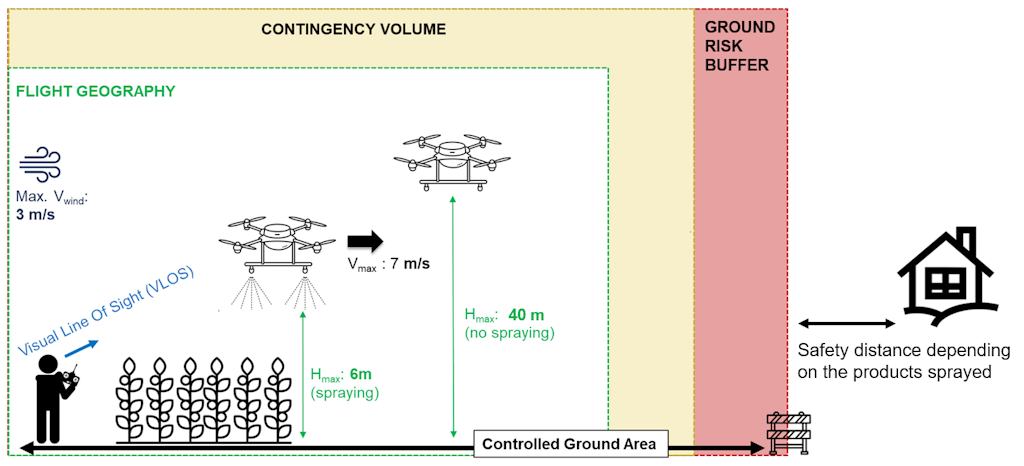
Operational conditions: regardless of the type of authorisation, the conditions specified in the FOCA-UAS-APP-AGRI form apply, including those relating to maximum flight height and speed, weather conditions and minimum distances from people.
In the cantons of Valais, Vaud and Geneva, numerous helicopters conduct aerial spraying operations. To ensure that drones and helicopters can safely share the airspace, additional requirements apply in these cantons, including the use of:
Applications are generally based on PDRA-S01, whose conditions are well suited to the types of operations and drones concerned. Applications may also be based on another PDRA or a SORA. In this case, applicants are advised to contact FOCA in advance.
Supporting documents, e.g. the operations manual and a copy of the permit for the use of plant protection products.
The safety distances intended to limit spray drift were revised in early 2026 on the basis of new data. The distances specified in the table below apply (condition #K of the FOCA-UAS-APP-AGRI form).
Chemical substances and preparations
Anyone releasing a substance or preparation into the environment must not endanger human health or adversely affect the environment. This also applies to drone spraying operations. Appropriate measures must be taken to prevent exposure of people and the environment to the product within the spraying area.
Chemical substances and preparations are subject to a reporting obligation, regardless of the quantity involved. New substances that have not been fully registered in the EU under the REACH Regulation must also be notified before being placed on the market, where the quantity amounts to one tonne or more per year (New substances at a glance).
The following two documents must be consulted before submitting an application:
In accordance with the principle of self-control, operators are responsible for checking whether any prohibitions or restrictions apply to the intended product. Relevant sources of information include the Common Notification Authority for Chemicals (FOEN, FOPH, SECO), the Chemicals Product Register (RPC) and the overview of applicable requirements on the FOEN website.
Applications are generally based on PDRA-S01, whose conditions are well suited to the types of operations and drones concerned. Applications may also be based on another PDRA or a SORA. In this case, applicants are advised to contact FOCA in advance.
Supporting documents, e.g. the operations manual and the safety data sheet.
Biocidal products
FOCA assesses the aeronautical aspects of the operation. The FOPH, FOAG, SECO and FOEN are responsible for matters relating to biocidal products. FOCA coordinates with these authorities.
Biocidal products may only be placed on the market and used professionally if they have been authorised, notified or recognised in accordance with the Ordinance on Biocidal Products (OBP; SR 813.12). The requirements applicable to each product can be found on the “Biocidal products” page of the Common Notification Authority for Chemicals.
Applications are generally based on PDRA-S01, whose conditions are well suited to the types of operations and drones concerned. Applications may also be based on another PDRA or a SORA. In this case, applicants are advised to contact FOCA in advance.
Supporting documents, e.g. the operations manual and the safety data sheet.
Organisms
The dispersal of organisms does not require a specific authorisation under chemicals legislation. However, aviation legislation requires authorisation from FOCA.
Applications are generally based on PDRA-S01, whose conditions are well suited to the types of operations and drones concerned. Applications may also be based on another PDRA or a SORA. In this case, applicants are advised to contact FOCA in advance.
Spraying pure water does not require authorisation under chemicals legislation. However, aviation legislation requires authorisation from FOCA. Spraying operations are not permitted under standard scenarios (STS), even when spraying water only. For operators using C5 or C6 drones, the simplest approach is to apply under PDRA-S01 or PDRA-S02. These correspond to STS-01 and STS-02 respectively, allowing for a simplified procedure and shorter processing times.
Responsibilities of UAS operators and remote pilots
In accordance with Commission Implementing Regulation (EU) 2019/947, UAS operators remain responsible for ensuring that their operations comply with the applicable regulatory requirements and with the conditions and limitations associated with their operational authorisation. This responsibility applies throughout the validity period of the authorisation.
An operational authorisation is not transferable (UAS.SPEC.070). The operator remains responsible for all operations conducted under its operational authorisation and must, at all times, retain organisational control over its activities and operational control over the UAS operations conducted under its responsibility, regardless of any contractual, economic or other relationships with the remote pilots concerned.
UAS operators are notably responsible for:
conducting operations in accordance with the applicable regulatory requirements;
implementing and maintaining the required operational procedures;
ensuring that remote pilots possess the necessary competencies and qualifications;
maintaining the required documents, records and logbooks;
retaining operational control over their activities;
reporting occurrences where required by the applicable regulations;
cooperating with FOCA during surveillance activities.
complying with the procedures and instructions established by the operator;
conducting UAS operations in accordance with the applicable conditions and limitations;
maintaining the competencies required for the operations performed;
reporting situations that may affect the safety or compliance of operations;
interrupting or not commencing a flight where the conditions necessary to conduct it safely are not met.
Detailed responsibilities applicable to remote pilots are defined in particular in point UAS.SPEC.060.
Oversight by the FOCA
In accordance with Article 18 of Commission Implementing Regulation (EU) 2019/947, the FOCA oversees UAS operators conducting operations in the Specific category to verify their continued compliance. To explain its oversight activities and the related expectations, the FOCA has published a dedicated Guidance Material.
Based on time spent, i.a.w. Art. 38, Para. 1, let. a of the Ordinance on the fees charged by the Federal Office of Civil Aviation (GebV-BAZL; SR 748.112.11).