
FASST-CH: improving safety in Swiss airspace
Disclaimer
In the context of FASST-CH, FOCA plans to incorporate in the course of 2027 an e-conspicuity mandate into the existing regulation. A one-year transitional period is planned thereafter.
In order to get financial support (through BV87b) for necessary investments in cockpit equipment to meet the forthcoming mandate, an application must be submitted by November 30, 2026, at the latest. Details on equipment requirements and financial support are available on Technology Recommendation.
For the specific case of paragliders, delta gliders, rigid wing hang gliders, electric hang gliders, see the relevant page.
In a nutshell
- The Federal Office of Civil Aviation (FOCA) wants to increase airspace users’ electronic visibility (e-conspicuity) in order to enhance safety.
- To this end, the FOCA commissioned the Future Aviation Surveillance Services and Technologies in Switzerland (FASST-CH) project to draw up a roadmap for airspace surveillance services and supporting technologies by 2035.
- By 2028, an i-conspicuity ecosystem is to be established in which all aircraft are electronically visible (e-conspicuity) and can communicate with one another, supported by a ground-based infrastructure.
- By 2035, a fully connected airspace is foreseen where real time data will be available to airspace users and surveillance.
- The FOCA calls on aircraft owners and pilots to equip their aircraft in accordance with the technology recommendation.
- Those who equip their aircraft may apply to the FOCA for financial support via the special funding scheme for air transport (BV87).
Since its early times, one of aviation’s principles is “see and avoid”: see other airspace users and avoid them. Several technologies have been introduced to support pilots in this task; but they do not properly interact. Even though most airspace users in Switzerland have at least one of these technologies onboard, the lack of interoperability is a safety issue.
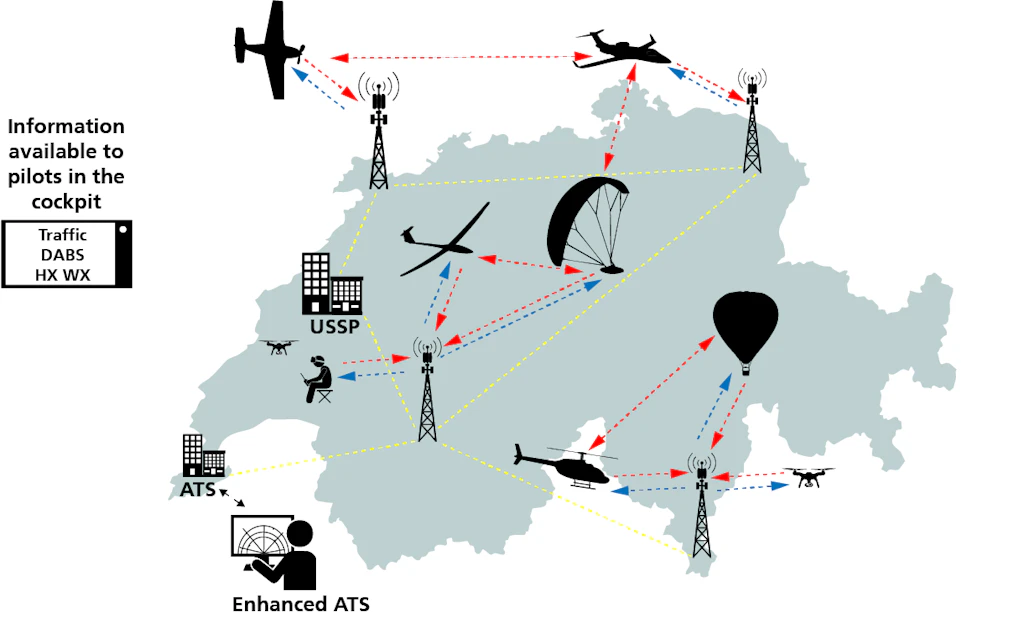
In 2023, FASST-CH (Future Aviation Surveillance Services and Technologies in Switzerland) was launched to tackle this issue in a broader context. The vision for 2035 developed within FASST-CH in collaboration with several Swiss and international stakeholders is a fully connected airspace where pilots can access traffic, weather and airspace status data in real time.
To this end, the FOCA is asking owners and pilots to ensure that their aircraft are electronically conspicuous using a limited set of technologies fostering interoperability, contributing thereby to make the airspace safer. A list of recommended technologies has been published for this purpose.
The envisioned airspace will build on an i-conspicuity ecosystem, to be achieved by 2028, where air to air interoperability of technologies will be complemented by a ground infrastructure, thus ensuring complete visibility of the surrounding traffic.