
Frequently asked questions on drones (FAQ)
Here you'll find the answers to the most frequently asked questions about drone regulations.
Identifying my drone class
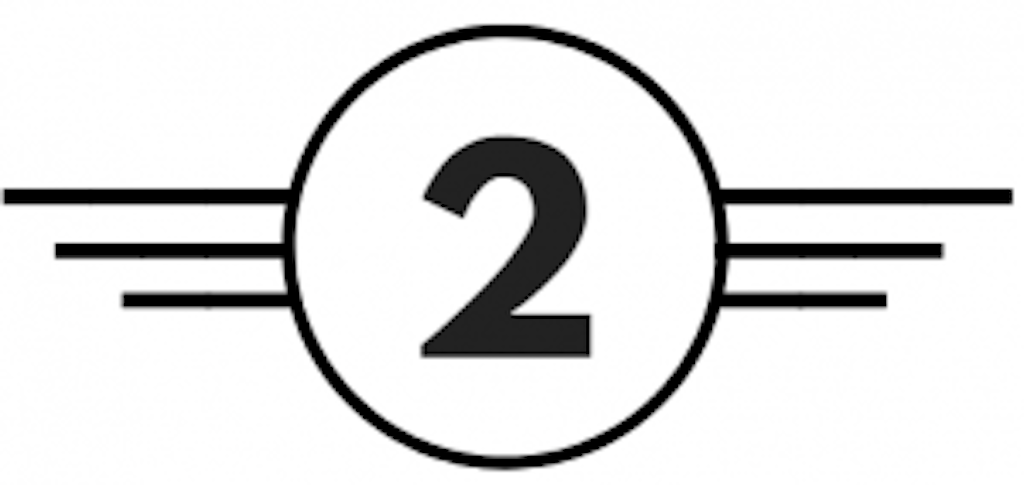
Representation of a C2 class identification label The class should be indicated on the drone packaging and in the user manual. There should also be a class identification label affixed to the drone by the manufacturer. For example, for class C2, the label looks like this.Only drones in classes C0, C1, C2, C3 and C4 may be operated in the open category. The class determines the subcategory (A1, A2, A3) in which the drone may be operated, and therefore the operating rules to be complied with.
Only class C5 (for EU-STS-01) or C6 (for EU-STS-02) drones may be operated in the specific category, in accordance with a European standard scenario (EU-STS).
Class identification labels are not required for flying under the PDRA (Predefined Risk Assessment) or SORA (Specific Operation Risk Assessment) authorisation procedures.
In applying a class identification label, the drone manufacturer confirms that the product meets the technical requirements. The manufacturer is responsible for ensuring that the technical requirements of the respective drone class are met.
.svg.png?w=1024&auto=format)
CE marking The CE marking can be displayed anywhere on the drone, for example on the top or bottom section of the fuselage or under the battery cover. The CE marking must also appear on the packaging, and the product must be accompanied by an EU Declaration of Conformity. If you cannot find these, it is likely that your drone does not comply with the legal requirements and should not be used. It is illegal to fly a drone which does not have a CE marking.The class identification label should not be confused with a CE marking.
CE markings allow manufacturers to declare a product meets all the relevant requirements with regard to health, safety and environmental protection. It is illegal to fly a drone which does not have a CE marking.
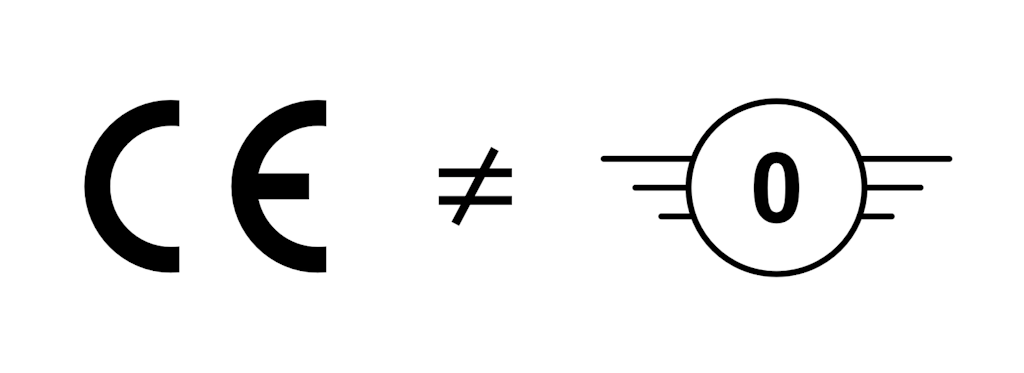 The class identification label is used only for drones and indicates that the drone meets the technical requirements for its class. Drones without a class identification label may not be flown in the open category or in a standard scenario (EU-STS).
Yes, if the drone was placed on the market in Switzerland or the EU before 1 January 2024 (known as a legacy drone). In this case, it may be operated in subcategory A1 (if it weighs less than 250g) or subcategory A3 (if it weighs less than 25kg).
If the drone was placed on the market on or after 1 January 2024 without a class identification label, it was built without regard to the safety requirements in force and may present a hazard, so it may not be flown.
No, in general only the manufacturer is authorised to affix a class identification label to the drone, after carrying out compliance checks and before it is placed on the market.
There is only one exception: if the drone was placed on the market before 1 January 2024 without a class identification label (legacy drone), the manufacturer may, in certain cases, allow the operator to return the drone so that it can be upgraded to comply with the new legal requirements. Alternatively, the operator may be given the option of simply updating the drone's internal software. The manufacturer will then send the operator a label to affix to the drone.
Operations
In this category you can use a drone without first obtaining an operational authorisation from the FOCA. All you have to do is complete the registration formalities and obtain the necessary certificate. You can then fly your drone respecting certain rules. The open category is subdivided into three subcategories, A1, A2 and A3. The subcategories differ slightly in terms of the certificate required and the distance that must be kept from uninvolved people. The class to which the drone belongs (C0, C1, C2, C3 or C4) determines the subcategory in which it can fly. You will find the rules applicable to the open category on the Flight rules page.
Almost all leisure flights and some flights for professional purposes are in the open category. Complex operations that cannot be carried out in compliance with the open category flight rules must take place in the specific category.
When an operation cannot be carried out in accordance with open category flight rules, it falls into the specific category. Operations in the specific category require an operational authorisation issued by the FOCA in accordance with one of the various authorisation procedures (STS, PDRA, SORA).
Because of the cost involved and the technical knowledge required of the operator, it is likely that the specific category will apply only to drone flights for professional purposes.
Registering as a drone operator
Yes, drone operators are required to register and must display their operator number prominently on each of their drones. The only people who are exempt from this requirement are operators whose drones weigh less than 250g and are not equipped with a camera, microphone or other sensor suitable for recording personal data.
However, the drone itself cannot be registered. The FOCA therefore keeps a drone operator register rather than a drone register.
No. The operator number is, as its name suggests, linked to an operator rather than to a drone. Operators register only once, regardless of the number of drones they operate. So an operator who owns several drones affixes the same operator number to each of their drones. An operator who sells a drone simply removes their operator number from the drone and the new owner affixes their operator number instead.
The UAS operator number (CHExxxxxxxxxxxxx-xyz) is issued after registration and must be clearly displayed on each drone. A remote pilot ID (CHE-RP-xxxxxxxxxxx) appears on the certificate you receive after passing a drone pilot exam – this is simply the certificate number, similar to the ID number on a driving licence. You don't need to do anything in particular with your remote pilot ID number.
Before using your drone, you must affix your operator number to it. This has the following format: CHExxxxxxxxxxxxx-xyz. The first part (CHE + 13 characters) must be clearly displayed on the drone.
The number can be affixed in a number of ways:
- written by hand (in legible block capitals, using a waterproof pen);
- sticker;
- plate;
- engraved directly on the drone.
It is a criminal offence to fly a drone with no UAS operator number.
The final three characters (xyz) should not be marked on the drone. However, you will need these three characters to check the validity of your operator number in order to activate the drone's remote ID function. To prevent your operator number being used by unauthorised persons, make sure you keep these three characters to yourself.
No. Administrators of an organisation registered in dLIS can manage the organisation’s data (address, insurance, etc.) and add or remove other administrators. It is advisable to have at least two administrators for each organisation. It is neither necessary nor desirable for all those who fly drones for an organisation to be registered as an administrator in dLIS. Furthermore, the administrator does not necessarily have to be a remote pilot.
It is not possible to link remote pilots to an organisation in dLIS; it is the operator’s responsibility to know which remote pilots are flying on its behalf.
In many cases, yes. Anyone who has registered in Switzerland (in dLIS) may also fly their drone in an EU member state, Liechtenstein, Norway or Iceland provided no further authorisation is required.
Other countries have different requirements. It's a good idea to find out more before you travel.
In principle, everyone should register in their country of residence. This means that if you move, you should transfer your registration. However, if you fly exclusively in the open category, you are only required to transfer your registration if it is cancelled by the country in which you are registered. To transfer your registration to Switzerland you must:
- register on the Swiss dLIS portal and
- cancel your registration made in the EU, Norway or Iceland. If you cannot deregister manually via the registration platform, contact the civil aviation authority in the country of registration directly (via email).
It should be noted that in some countries certificates are linked to registration. In such cases, deregistering will invalidate your certificates and you may need to resit the exams. You should contact the country of registration for information before deregistering.
Only registered operators are allowed to fly a drone in Switzerland. Operators domiciled in the EU, Norway or Iceland must register in their country of residence and are not allowed to register in Switzerland.
However, operators whose residence or registered office is outside the EU, Norway or Iceland must register in Switzerland if they have not already done so in an EU member state, Norway or Iceland.
No, unmanned aircraft are not entered in the aircraft register. They are not registered in the same way as, for example, an aeroplane. There is currently no register for drones.
Training and exams for remote pilots
Yes. There is a general requirement to undergo an online training course and pass an exam. Remote pilots operating a drone weighing less than 250 grams (class C0 or legacy drone weighing less than 250g) are exempt. However, the FOCA recommends that these remote pilots take the training course and pass the exam, as all pilots should be familiar with the regulations in force and operate their drones in complete safety.
Yes. Certificates issued on dLIS are valid in Switzerland and in all EU member states, Liechtenstein, Norway and Iceland.
Yes. Certificates registered on the former official UAS.gate platform before the EU drone regulation came into force in Switzerland are still valid. Pilots can download an updated version of the certificate bearing the EASA logo in their dLIS profile. These certificates are also recognised in EU member states, Liechtenstein, Norway and Iceland. However, certificates issued on a voluntary basis by other providers are not recognised.
No. Only natural persons can obtain a certificate. A legal entity can only be an operator.
Yes. A1/A3, A2 and STS certificates issued in an EU member state, Norway or Iceland are valid in Switzerland.
This is not possible, but certificates obtained in an EU country, Norway or Iceland are valid in Switzerland without any special procedure.
Operational authorisations issued by the FOCA (specific category)
You have to be authorised to operate a drone in the specific category. The authorisation procedure depends on the type of operation planned:
- Standard scenario (EU-STS);
- Pre-Defined Risk Assessment (PDRA);
- Specific Operations Risk Assessment (SORA).
The requirements depend on the type of operational authorisation:
- Standard scenario (EU-STS): A1/A3 training and exam followed by STS theory exam and practical skills training.
- Pre-Defined Risk Assessment (PDRA): The skills necessary depend on the particular drone operation.
- Specific Operations Risk Assessment (SORA): The skills necessary depend on the particular drone operation.
The authority responsible for issuing an operational authorisation is always that of the country of registration. You can operate a drone abroad if you have already obtained authorisation in the country of registration. Apply to the competent authority of the country where the drone operation is to take place, providing the authorisation issued in the country of registration and information about the planned flight area and appropriate risk reduction measures. The authority abroad will examine the request and tell you whether or not the flight is authorised.
For more information, see Cross-border operations (CBO).
There are a number of SORA consulting firms active in Switzerland. The FOCA does not keep a list of such companies or make any specific recommendations.
Data protection, privacy and ownership
Drone operators have to respect the privacy of others. The Federal Data Protection and Information Commissioner (FDPIC) is responsible for answering any questions on this subject. A lot of information is available on the FDPIC Photos and video surveillance webpage.
All local residents have the right to privacy. You should therefore avoid filming through windows or only do so if all the people concerned have been informed and have given their consent. A lot of information on data protection is available on the FDPIC Photos and video surveillance webpage.
A lot of information on data protection is available on the FDPIC Photos and video surveillance webpage. In all cases, please pay attention to the following:
- You must notify the owner or tenant and any other people in the garden or on the plot beforehand and obtain their consent.
- Everyone has the right to privacy and protection against the misuse of their personal data. Furthermore, they must decide whether or not they wish their information to be processed or stored and how it is to be used.
- Consent must also be given to store the images, on whatever medium.
Even if your drone is not equipped with a camera or other sensors that can collect personal data, you must respect the private property of third parties and their right to unrestricted enjoyment of their property. Even if airspace is public property, ownership extends above the ground to the full height required for its use. In other words, you should avoid flying your drone in a garden that is not your own, or at low altitude over the property of third parties, without first obtaining the consent of the people concerned.
Flying rules
Drones operated in the open category may not fly more than 120 metres from the nearest point on the ground. In other words, when flying over terrain with natural elevations, the drone must remain no more than 120m above the nearest point on the Earth's surface. The nearest point is measured perpendicular to the ground. If you need to fly over an obstacle that is taller than 120m, you are permitted to fly up to 15 metres above the height of the obstacle. NB: You must first obtain the consent of the owner of the obstacle. The distances are measured from the prevailing terrain i.e. plains, hills and mountains.
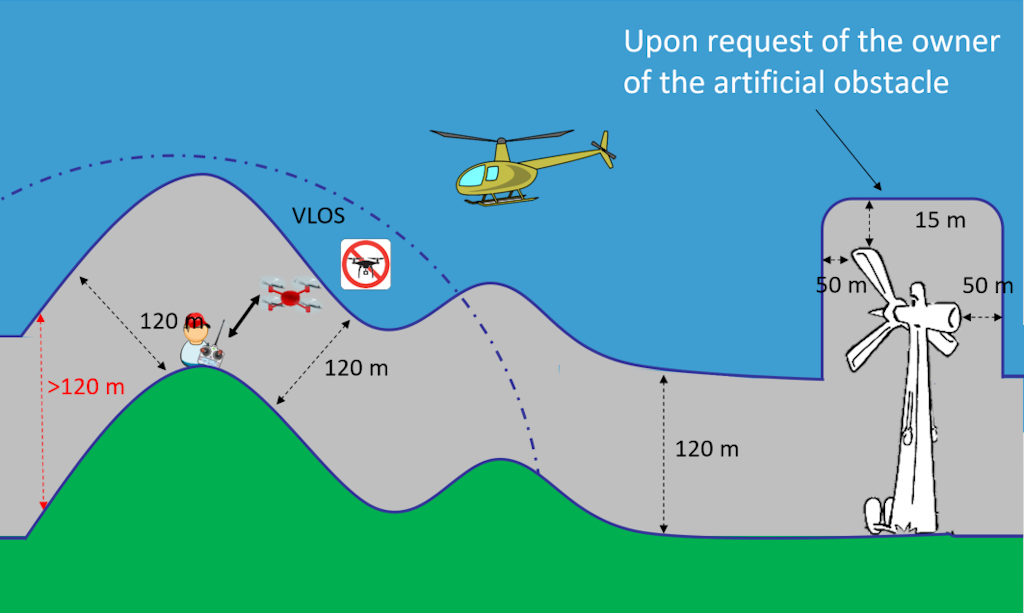
NB: Class C0 drones have a technical limitation of 120 metres above the point of take-off, which may be more restrictive.
In the open category, it is forbidden to fly over assemblies of people. To do so, a SORA operational authorisation is required.
An assembly of people is any group of people in which at least one person is unable to move away/move freely at any time, for example at a concert, a public event, etc.
In some subcategories of the open category, it is nevertheless permitted to fly alongside assemblies of people. To find out more, visit the page Flight rules for drones on this website.
The flight rules for the open category do not specifically address cities or other built-up areas. Operators and drone pilots must consider whether it is feasible to fly in a particular area, taking into account the ban on flying over assemblies of people and the safe distance that must be maintained from people not involved in the operation. The applicable minimum safe distance depends on the subcategory (A1, A2, A3) in which you fly your drone. The drone pilot must therefore ensure, prior to flying in a built-up area, that they are able to maintain a safe distance.
In Switzerland, the minimum age for operating a drone is 12 in the open category and 14 in the specific category. Children under the age of 12 may pilot a drone provided they are supervised by a person over the age of 16 who has adequate piloting skills (training, examination).
The minimum age is likely to be different in EU countries, so be sure to find out before flying your drone abroad.
A Class C2 UAS may be operated in subcategory A2 or A3. For operation in subcategory A2, the A2 certificate is required. If you wish to operate it only in subcategory A3, only the A1/A3 certificate is required.
A drone – since it contains a radio transmitter and/or receiver – constitutes radio equipment. As such it is subject to the Telecommunications Act. Questions relating to frequencies fall within the remit of the Federal Office of Communications (OFCOM). Further information is available on the Drones and model aircraft page of the OFCOM website.
The use of transponders is only possible in certain cases. The FOCA has published a directive on the use of transponders and ADS-B for drones. This can be found on the Specific Operations Risk Assessment (SORA) webpage.
Strictly speaking, there are no rules governing drone take-off and landing on land where there is no aeronautical infrastructure. The Off-Aerodrome Landing Ordinance (SR 748.132.3) does not apply to drone operations. The agreement of the landowner (private individual or authority) is required, particularly when take-offs and landings may cause excessive disturbance.
Geographical restrictions
Yes. The restrictions indicated on the drone map and the DABS (Swiss Daily Airspace Bulletin) apply.
More information is available on the Geographical flight restrictions page.
Yes, aerodromes are free to charge for authorisation to fly in the 5km zone around the aerodrome with a drone weighing more than 250g. While aerodromes with a concession must respect the principle of proportionality, other aerodromes (airfields) are free to set their own rates. If the prices charged by an aerodrome seem excessive, you can raise the matter with the Office of the Price Supervisor (page not available in English).
Insurance
Yes. Anyone operating a drone weighing more than 250g must take out personal liability insurance with a guaranteed sum of at least CHF 1 million. The FOCA also recommends having insurance when operating lighter drones.
Please contact your insurance company to ensure that your policy covers your needs. If you are not insured, you could be fined.
If the operator and the pilot are not the same person (for example, when a pilot uses a drone on behalf of their company), the pilot does not need personal liability insurance to fly the drone.
No, the register of drone operators is not accessible to the public or to insurance providers.
Flying special drones
People using drones classified as toys weighing less than 250g do not need to register as a drone pilot. There is no minimum age for flying a toy drone under current regulations, but the minimum age stipulated by the manufacturer must be respected.
A drone can be considered a toy if it is designed or intended for use by children under the age of 14, in class C0, and if it complies with the requirements of Directive 2009/48/EC (European Directive on the safety of toys). The manufacturer must clearly indicate on the drone's packaging whether or not it is to be considered a toy, for example by stating ‘Not suitable for children under the age of 14’.
Yes, it is permitted to fly privately built drones. A drone and its equipment are considered privately built if they are assembled or built for the constructor's personal use (i.e. private, not commercial). This does not include drones assembled from sets of parts placed on the market as a single ready-to-assemble kit. To find out in which subcategory your drone can be flown, go to the section entitled ‘Privately built drones’ on the Flying rules page.
Three factors generally apply:
- Purpose of the flight: Model aircraft are generally used for sporting, leisure, training or demonstration purposes.
- Model aircraft are always operated with direct visual contact.
- The aim of model aircraft making is to acquire the skills to fly a model aircraft and have fun doing so. Any autonomous capacity is only used for altitude stabilisation and in emergencies.
Special uses of drones
Outdoor FPV flights are permitted under the following conditions:
- The pilot is assisted by an observer who stands beside them and has the drone within their visual line of sight (VLOS) at all times;
- The observer visually scans the entire airspace and actively communicates with the pilot to help them maintain the minimum distance from obstacles and other air traffic. The observer is able to warn the pilot of any hazards.
In all cases, it is the pilot's responsibility to fly the drone safely.
In cases where the observer cannot maintain a direct line of sight with the drone at all times, the flight must take place in the specific category and authorisation from the FOCA is therefore required. Authorisation from the FOCA must also be obtained before a FPV drone race.
No. Whether or not a drone is flown recreationally has no bearing on the risk of drone operation. What is more important is the mode of operation, i.e. how, where and which drone is operated.
Yes. The operating rules for the open category must be complied with. If you cannot do so, the drone operation falls into the specific category and authorisation must be obtained from the FOCA.
In Switzerland and Europe, no people have been transported using drones to date. Passenger transport with drones is highly complex. The operation and the flying object itself must go through a certification process. The relevant rules are still under development.
Enclosed areas are not part of airspace. The rules on drones therefore do not apply. It is nevertheless important to exercise caution.
Yes. You should activate a green flashing light on your drone when you are flying at night. Please note that, even at night, you must always comply with requirements relating to the visual line of sight (VLOS). This means that you must visually scan the airspace surrounding your UAS to ensure there is no risk of collision with a manned aircraft. This means that you cannot fly as high as you can during the day.
Further questions
Yes. Serious incidents involving drones and accidents involving manned aircraft or causing serious injury or death must be reported. However, you are encouraged to report any incident or accident voluntarily.
Two distinct reporting procedures apply depending on the case:
- Firstly, drone operators/pilots are required to report accidents and serious incidents without delay to the Aviation division of the Swiss Transportation Safety Investigation Board (STSB) via the Rega alarm centre (tel. 1414, +41 333 333 333 from abroad).
- Secondly, drone operators/pilots are required to report all safety-related incidents within 72 hours to the Federal Office for Civil Aviation (FOCA) or on the official reporting system ECCAIRS.
Further information can be found on the Report accidents page of this website.
EASA defines a flight as autonomous when the drone makes its own decisions and the remote crew are unable to intervene in flight operations.
Automatic operations, on the other hand, involve predetermined routes or behaviours where the remote crew can always take control if necessary, for example in the event of unforeseen events.
Implications:
- Autonomous flights are not authorised in the open category and therefore fall under the specific or certified category.
- Automatic flights are authorised in all three categories.
The maximum take-off mass (MTOM) is the absolute maximum weight (mass) that the manufacturer authorises for the drone.
If the total weight of the drone plus battery is 1kg and the MTOM is 1kg, you can't add anything to it. If the total weight of the drone plus battery is 1kg and the MTOM is 2kg, the payload can be up to 1kg, provided the manufacturer allows it.
The MTOM and whether or not a payload can be added are determined by the manufacturer and set out in the user manual.
The rules explained on the website are legal requirements that you, as a drone pilot, must always respect, just like the laws you must respect when driving a car. It is a criminal offence to breach these rules.
If you witness an offence, please report it to the police.
Index
- Identifying my drone class
- Operations
- Registering as a drone operator
- Training and exams for remote pilots
- Operational authorisations issued by the FOCA (specific category)
- Data protection, privacy and ownership
- Flying rules
- Geographical restrictions
- Insurance
- Flying special drones
- Special uses of drones
- Further questions